

Looking Back, the Pattern Was Always There
About thirty years ago, I translated New Venture Creation by Jeffrey A. Timmons — a Harvard Business School textbook on entrepreneurship — into Japanese.
At the same time, I began my own journey of building and supporting startups in Japan.
I genuinely believed that Japan would become a place where founders could take risks, fail, recover, and try again — naturally and repeatedly.
I believed failure would be part of the process, not the end of it.

Translated by Nobuji Kanai, reflecting early efforts to bring venture strategy and entrepreneurship thinking to Japan.
That future, however, did not arrive as I had imagined. Japan entered what later became known as the “lost 30 years.”
For many founders, a first failure often became a final one. I did not fully grasp the weight of that reality at the time.
It only became clear much later — through my own ventures, and through dozens of startup projects I was deeply involved in — how unforgiving early mistakes could be in Japan.
The cost was not immediate. It accumulated quietly, and revealed itself years later.
The Real Cause of Failure Was the First Decision
Looking back, most failures were not caused by a lack of effort later on.
They originated from small misalignments at the very beginning: assumptions, choices, and preparation.
Those misalignments were often hidden under optimism and growth expectations.
In Japan, especially, correcting course midstream was extremely difficult. The longer you pushed forward, the higher the cost became.
I know this structure well ― personally and professionally.
And fundamentally, this structure has not changed.
Why I Returned to the “Startup Quadrant” Framework
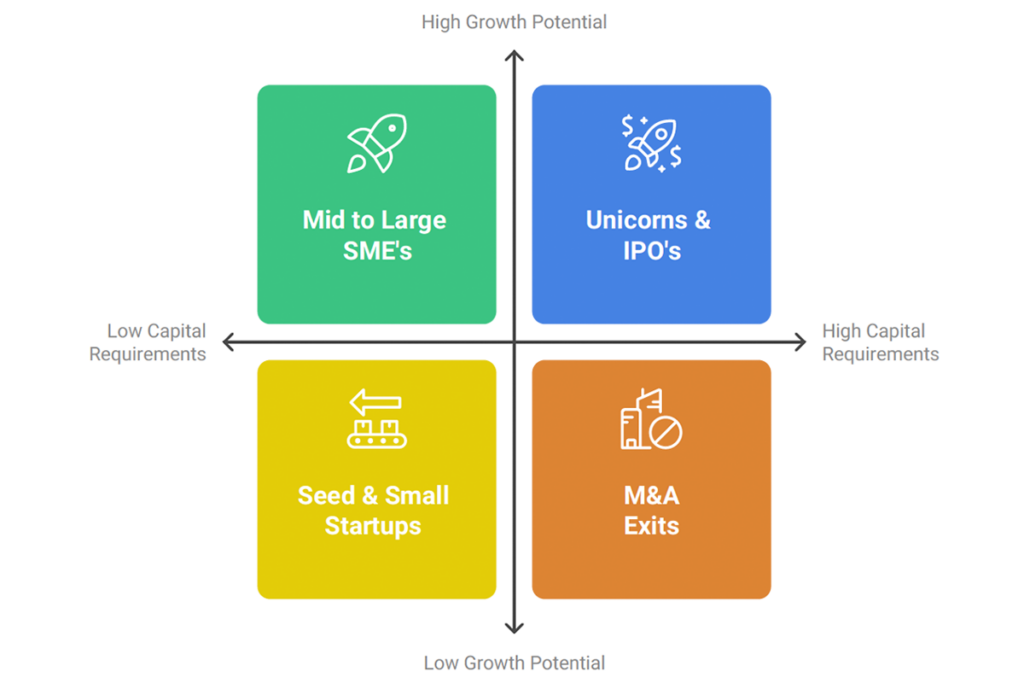
That is why I came back to what I call the Startup Quadrant. This is not a diagram to classify success or failure.
It is a map that helps founders decide which game they are actually playing. Most importantly: the choice of quadrant belongs to the founder. It is a map that helps founders decide which game they are actually playing. Most importantly: the choice of quadrant belongs to the founder.
Not the market. Not investors.
What Must Be Decided First in Each Quadrant
① Seed & Small Startups (Low Growth × Low Capital)
Here, control and flexibility matter most.
- Bootstrapping and founder capital
- Startup loans
- Small, repeatable execution
The risk is stagnation ― staying small without a clear growth vision or strategy. When preparation and expectations fall out of sync, instability follows.
KANAI&CO case example:
An AR platform startup executed a PoC within six months of incorporation in Japan, leveraging a JPY 5 million startup loan and a JPY 2.5 million Small Business Subsidy.
② Mid to Large SMEs (Moderate to High Growth × Moderate Capital)
This quadrant prioritizes sustainable expansion and stability.
- Founder capital
- Japan Finance Corporation (JFC) loans
- Bank financing and institutional funding
The key is not whether to grow, but how to grow. Here, business plans must emphasize execution feasibility and capital recovery.
KANAI&CO case example:
A startup ecosystem business expanded operations using a JPY 48 million SME loan and a JPY 40 million New Business Entry Subsidy.
③ Unicorn & IPO-Oriented Startups (High Growth × High Capital)
This quadrant must be designed for rapid scaling from day one.
- Angel and VC funding
- Scalable business models
- Teams and narratives that explain growth and risk
Business plans here are not just fundraising tools ― they are blueprints for speed and risk management.
KANAI&CO case example:
An IT infrastructure startup and a succession-focused M&A platform secured JPY 30 million in seed funding alongside Japan market entry support. Both were graduates of global accelerator programs.
④ M&A Exit-Oriented Startups (Moderate Growth × High Capital)
An IPO is not the only rational exit.
However, M&A requires intentional design from the beginning: who the buyer is, what value is transferred, and how. Waiting to think about this later is often too late.
Japan’s aging SME owner base means millions of businesses face succession issues. M&A opportunities are expanding rapidly ― including for startups and large corporates seeking open innovation.
Example:
Up to JPY 10 million in Succession & M&A Subsidies can be applied to advisory services and M&A investments.
What Happens When Quadrants Are Mixed
The most common failure pattern is mixing assumptions from different quadrants:
- VC-style growth expectations with non-VC capital structures
- SME financing paired with unicorn-level plans
- Small businesses attempting premature expansion
These problems are subtle at first ― and irreversible later. I have seen this pattern across more than 100 startups.
Japan Is Entering a Different Phase
Japan is often criticized for lagging behind in the startup sector.
Yet since the Kishida administration’s Startup Development Plan in 2022, the ecosystem has changed meaningfully:
- Unsecured institutional financing for startups
- Subsidies reaching tens of billions of yen
- Regulatory reforms around stock options
- Startup visas for foreign founders
For the first time, what was impossible thirty years ago is becoming realistic.
Foreign-founded startups can now build global unicorns from Japan. Others can grow sustainably within the quadrant that best fits them.
Both are valid paths.
We Are Standing at a Real Inflection Point
Today, founders face options that did not exist before. That is why the first decision matters more than ever.
- Which quadrant are you choosing?
- How will you connect with Japan’s ecosystem?
- Are you prepared ― structurally, not emotionally?
Are you ready to make that decision?
Where This Leads Next
If parts of this article resonate with your current situation, we share concrete cases, decision frameworks, and execution paths through
Japan Market Entry Intelligence.
Not theory ― but practical navigation.
Japan Market Entry Intelligence – Strategic Briefing for Global Startups & Investors
Which quadrant are you preparing for?
I look forward to connecting further.
References / Further Reading
New Venture Creation is a globally recognized textbook in the field of entrepreneurship education and has been widely adopted by universities around the world, including Japan.
The first edition was authored by Professor Jeffrey A. Timmons in the 1970s. Over multiple subsequent editions, the book was revised and expanded, and later editions were co-authored with Stephen Spinelli Jr., who went on to serve as President of Babson College. Professor Timmons earned his doctorate at Harvard University and made significant contributions to the systematization of entrepreneurship education during his tenure at Babson College.
Following Professor Timmons’ passing in 2008, the core concepts and frameworks of New Venture Creation have been carried forward by Professor Spinelli and others, and the English editions continue to be used internationally today.
While the Japanese edition—translated by Nobuji Kanai—is now out of print, the ideas discussed in this article, including the Startup Quadrant and the importance of early-stage assumption design, are rooted in the enduring questions consistently explored throughout the book.
This article reinterprets those foundational frameworks in the context of today’s Japanese and global startup environments.