
Rethinking What “Global” Really Means
When people talk about “global startups” in Japan, the term often carries different meanings depending on who is speaking.
For some, “global” means expanding overseas.
For others, it means dealing with foreign clients or investors.
At KANAI&CO, we define “global” more structurally — as the interaction of three interconnected phases:
- Inbound: Foreign founders building companies in Japan
- Local: Japan’s institutions, talent, and startup ecosystem
- Outbound: Japanese startups expanding beyond Japan
True globalization happens when these three are connected — not treated as separate worlds.
Why Japan Has Become a Destination for Founders
Japan is quietly becoming a destination country for entrepreneurs.
Not just tourists — but people who choose to build businesses, develop technology, and commit long-term.
This shift is driven by several factors:
- Political and social stability
- A rapidly improving startup support environment
- Strong public financing and subsidy programs
- A renewed national focus on innovation and startups
Foreign founders are increasingly choosing Japan not as a temporary stop, but as a base.
What Foreign Entrepreneurs Bring to Japan’s Ecosystem
Foreign entrepreneurs do more than create individual companies.
They bring:
- Growth-oriented business mindsets
- Higher risk tolerance and willingness to invest ahead of revenue
- Experience building companies from zero
- Global networks and diverse talent perspectives
Research by the Japan Finance Corporation Research Institute shows that foreign-led companies in Japan tend to demonstrate stronger growth orientation, higher willingness to pursue new markets, and a higher proportion of founder-led businesses compared to Japanese-led firms.
These characteristics matter — not only for individual success, but for the vitality of the ecosystem as a whole.
Japan’s Startup Support System: A Five-Year National Commitment Now Bearing Fruit
In 2022, the Japanese government launched an ambitious national initiative: the Startup Development Five-Year Plan, introduced under the Kishida administration.
This plan marked a clear policy shift. Japan officially declared startups — including globally minded and foreign-led ventures — as a core engine of long-term economic growth. The goal was not incremental improvement, but structural transformation:
to build a globally competitive startup ecosystem capable of producing 100 unicorns, mobilizing JPY 10 trillion in startup investment, and positioning Japan as Asia’s leading startup hub.
Today, in the middle of this five-year window, many of these policies are no longer theoretical.
They are actively being implemented — through financing, subsidies, talent programs, deep-tech support, and open innovation mechanisms.
👉 Official reference documents
- 📄 Startup Development Five-Year Plan (PDF – Official, Cabinet Secretariat)
- 📄 Startup Development Five-Year Plan (PDF – English Translation by KANAI&CO)
These documents provide the policy backbone behind Japan’s current startup support system.
Japan’s Startup Support System: Powerful, but Structurally Hard to Access
Today, Japan offers one of the most comprehensive startup support environments globally.
Examples include:
- Japan Finance Corporation startup loans
Up to JPY 72 million, unsecured and without personal guarantees, available before or shortly after incorporation. - SME Agency and METI subsidies
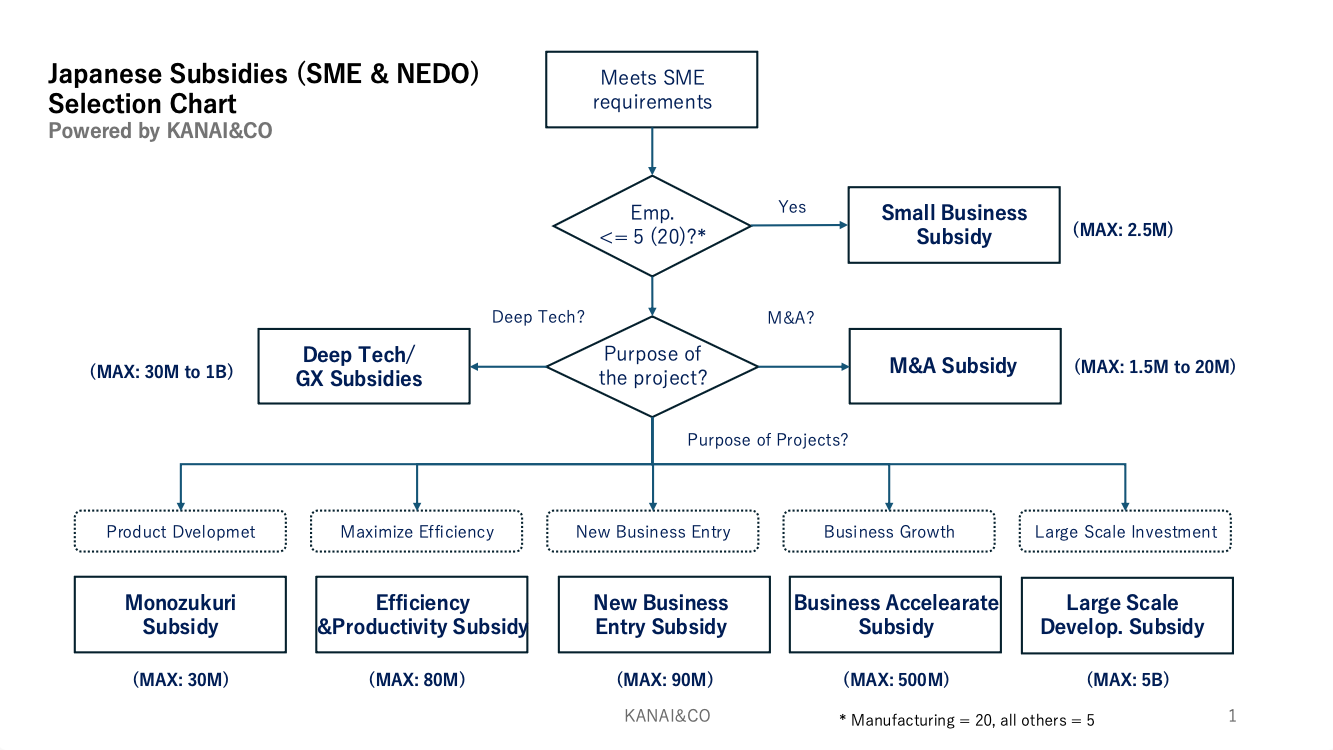
Ranging from JPY 500,000 to large-scale programs reaching JPY 5 billion, depending on stage and ambition. - NEDO’s Deep Tech Startup Support (DTSU)
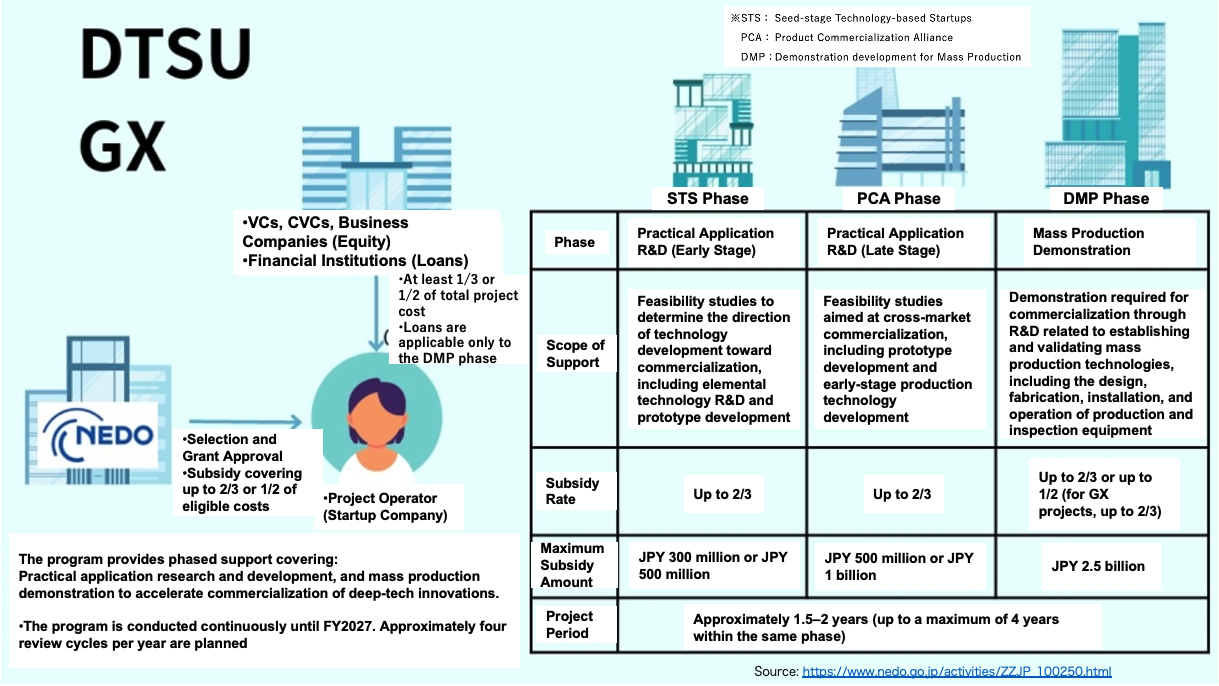
Up to JPY 3 billion over six years, supporting R&D-intensive startups even before revenue, typically alongside VC investment.
(See the subsidy selection chart and DTSU overview image below.)
Despite this, many foreign founders cannot access these programs effectively.
The barriers are rarely about eligibility alone.
They are structural: language, documentation, local norms, advisor selection, and the isolation that comes with building in a foreign system.
A Moment of Realization at CIC Tokyo
This structural gap became clear to me during an experience at CIC Tokyo (Cambridge Innovation Center Tokyo) in Toranomon.
On the same day, in the same venue, two discussion sessions were being held simultaneously.
One session focused on:
- The challenges foreign founders face when operating businesses in Japan
- Hiring Japanese managers
- Navigating local regulations and organizational culture
The other session focused on:
- Japanese startup founders managing overseas subsidiaries
- Communicating with foreign executives
- Negotiating and operating across borders
The two discussions were completely separate. There was no overlap. No exchange of perspectives. And yet, the challenges being discussed were deeply connected.
At that moment, I felt something was fundamentally off.
Foreign founders struggled to access Japan’s ecosystem. Japanese founders struggled to operate globally.
These are not separate problems. They are two sides of the same structural gap — and solving one without the other will never work.
Why These Two Worlds Must Connect
From my own experience working abroad and later supporting founders in Japan, I am convinced of this:
When foreign entrepreneurs succeed locally in Japan:
- They gain access to Japanese know-how, institutions, and trust-based networks
- Japanese startups gain exposure to global talent, perspectives, and collaboration
- Globalization happens locally, through people — not theory
This interaction is essential for Japan’s next phase of startup growth.
KANAI&CO’s Approach to Global Startup Consulting
KANAI&CO addresses this gap through its Global Startup Consulting services,
starting with inbound success — helping foreign startups succeed locally in Japan — and then connecting that success to Japan’s broader startup ecosystem.
We do this through two core service lines.
Japan Entry Bridge
Supporting foreign founders in their initial Japan entry:
- PMF review for the Japanese market
- Market entry strategy
- Company incorporation and structure (GK / KK, parent-subsidiary design)
- Smooth acquisition of Business Manager visas
Japan Startup Gateway
Helping startups integrate and grow within Japan’s ecosystem:
- Accessing public funding, loans, and subsidies
- Strategic business and growth planning
- Ecosystem partnerships and collaboration
- Talent, incentives, and organizational design
- Go-to-market and collaboration strategies
Why This Matters Now
Japan is at a turning point.
After decades of stagnation, the country is repositioning itself toward growth, innovation, and openness.
⇒ Foreign founders are arriving.
⇒ Public systems are evolving.
⇒ Ecosystems are forming across regions.
The question is no longer whether Japan can attract global startups — but whether it can help them succeed, integrate, and contribute meaningfully.
That is the role Global Startup Consulting is meant to play.
Where This Leads Next
What we’ve outlined here is only the starting point.
As more founders choose Japan as a place to build,the real challenge is no longer access to information —but understanding how to think, decide, and act within the system.
This is what we explore next.
📩 Continue the Thinking, Step by Step
If this article resonates with challenges you’re currently facing, we share the perspectives, decision-making frameworks, and execution-level insights we use in practice — step by step, via email.
・Not headlines.
・Not theory.
・But the thinking behind real decisions.
👉 Japan Market Entry Intelligence – Strategic Briefing for Global Startups & Investors:
Japan is becoming a destination for global founders.
Our goal is to help make it a place where they can truly succeed — and where that success strengthens the entire startup ecosystem.